My Journey Through Fitness Wearables
From college basketball to jiu-jitsu mats—how I went through four different wearables trying to find the one that actually fit my life
It’s no secret there are an overwhelming amount of options for fitness wearables these days. And if you ask ten people which one is the best, you'll probably get ten different answers. Apple Watch. Garmin. Oura. Fitbit. Whoop...
I've been on my own winding path through the wearable tech landscape, and honestly? It's been a journey of trial and error, figuring out what actually matters to me. Not what the marketing says. Not what the influencers are talking about. Just... what works for the way I actually live and move.
So let me take you through it.
The Beginning: Catapult and College Basketball
My first real introduction to wearable fitness tech wasn't even something I bought, it was something I wore as part of a research project under the Sports Performance Program during my time as a college basketball player at UC San Diego.

We were lucky enough to be one of the teams involved in using Catapult Vector devices. These things weren't exactly consumer-friendly... we wore them in the back of adaptive sports bras during practices and games, and they tracked every jump, every cut, every sprint. The data was incredibly granular: acceleration, deceleration, player load, all of it. Now, this was back in 2019 and since then, Catapult has made some pretty cool advances in the field so you should check them out!
What made it especially interesting for me was that I also interned for the school’s Sports Performance department at the time. So I wasn't just generating the data, I was helping process it, building dashboards, working with force plates and other performance tech. It was my first real glimpse into how powerful wearable data could be when you actually knew what to do with it.
But here's the catch: this was all high-level sports performance stuff. Not exactly something you wear to track your morning run or log a weightlifting session. When college ended, so did my access to that kind of advanced tech.
The Apple Watch Era (2020-2022)
Fast forward to 2020. I started working remotely and actually had a health and wellness subsidy through work. Like many active people during this time, I was doing more at-home workouts and outdoor activities. But I wanted to really focus more on what fitness looked like for me as a “retired” college athlete. As already a member of the Apple ecosystem, I started with what I knew, the Apple Watch.
Apple Watch
Primary Activity: Weightlifting, Running
What Worked:
- Intuitive interface
- Great for tracking weightlifting sessions
- Seamless integration with fitness/ running apps like Strava & Nike Run
- Activity rings kept me motivated
The Deal-Breaker:
- A bit bulky, even the smaller screen size on the series 6
- Felt more like a phone on my wrist than a fitness tracker
- The "smart" features became distracting
Look, I know for most people, the notifications and smart features are a pro. But for me? It was too much. I didn't want my wrist buzzing every time someone sent me an email or a Slack message. Yes, I know you can adjust the notification settings but with all the additional bells and whistles, came quite a bit of bulk. The screen became distracting. I wanted a fitness tracker, not a second phone.
So I stopped wearing it. For a while, I just... didn't track anything. And honestly, that was fine. Until I started getting curious about the stuff that wasn't just activity-based.
The Ring Phase: Ultrahuman (2024-2025)
By 2024, I was getting more interested in the bigger picture of health—sleep, recovery, stress, all the things that happen when you're not working out. I'd been hearing about the Oura Ring, which seemed perfect... except for that subscription fee. At the time, I just wasn't sold on paying monthly for data that should be mine anyway.
Enter Ultrahuman Ring. No subscription. Solid metrics. So I gave it a shot.
Ultrahuman Air Ring
Primary Activities: Weightlifting, Triathalon Training, Jiu-Jitsu
What Worked:
- No subscription model
- Good sleep insights (when accurate)
- Minimal, sleek design
- Learned a lot about my sleep patterns
The Problems:
- Sleep tracking wasn't always accurate (missed bathroom breaks entirely)
- Live activity tracking is still in Beta mode
- Terrible for weightlifting—constantly had to take it off
- Really not ideal with jiu-jitsu
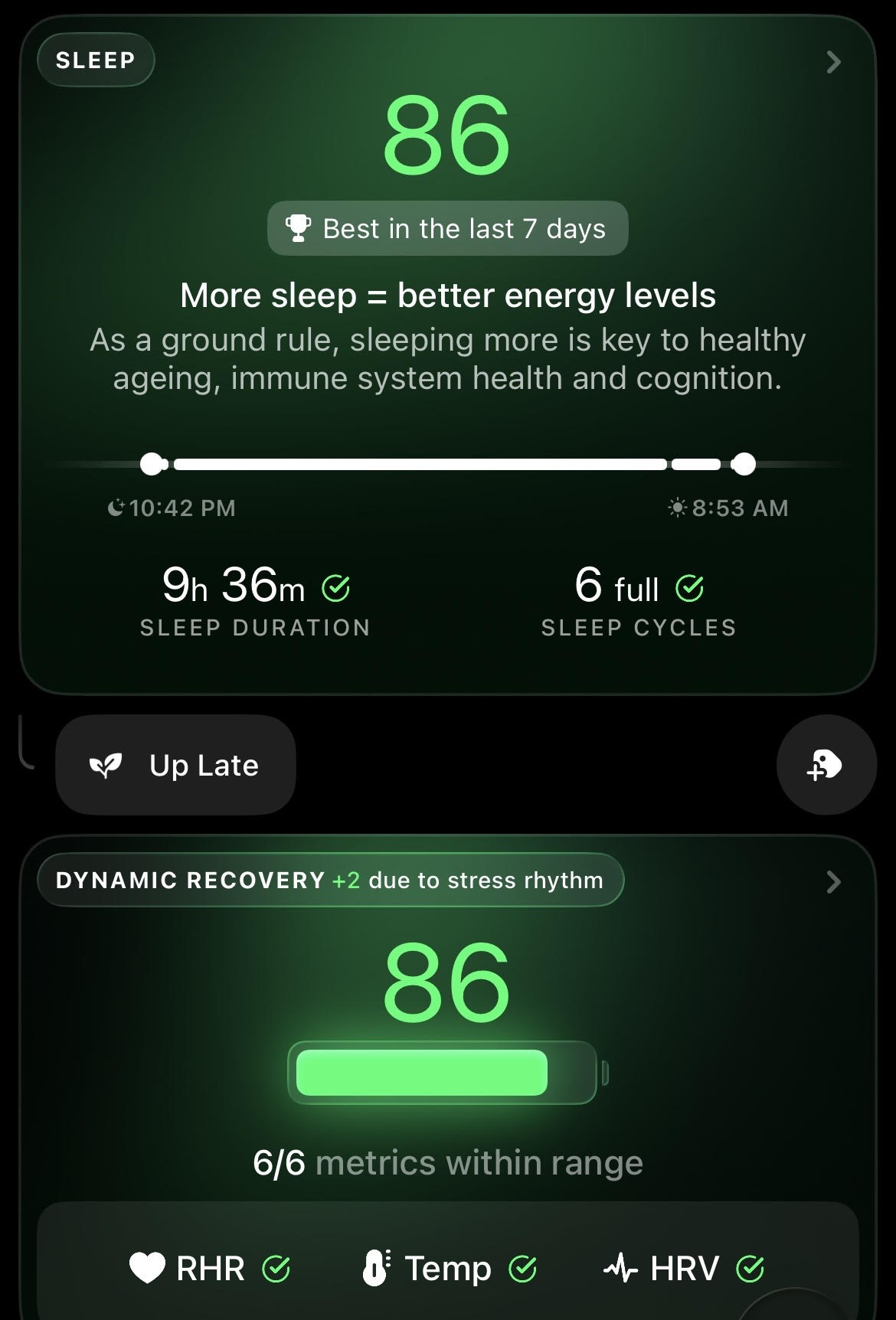
Honestly, Ultrahuman had some really cool features I hadn't seen before like sleep and recovery scores along with an interesting caffine window and circadian rhythm insights for light exposure and sleep timing. This was my first real introduction a fitness tracker that offered a more holistic view of my health and access to tracking things like heart rate variability (HRV) and VO2 max. These new insights really helped me keep my body on track, especially as I moved through more intense activity like training for a triathalon and tough mudder.
After about a year and a half of use, I understood my sleep patterns, learned some recovery basics, but the device just couldn't keep up with how I was actually moving through life. I had started transitioning away from running and leaned more into my weightlifting and a new hobby I had found, jiu-jitsu.
Grabbing weights with a ring on your finger? Not ideal. Rolling in jiu-jitsu with a ring? Potentially dangerous. And when your two main activities are things you can't even wear your tracker for... what's the point?
A note on sleep tracking: I had multiple nights where I woke up, went to the bathroom, scrolled my phone for a bit, and came back to bed. The Ultrahuman showed uninterrupted sleep. I know I was awake. That kind of thing erodes trust pretty quickly.
Where I Am Now: Whoop
Which brings me to my current setup: Whoop.
I'll be honest, I was hesitant about another subscription model. But Whoop offered a full free month trial, which gave me actual time to test it in my real life (not just a week where I'd still be figuring out how it worked). And more importantly, I’ve only worn Whoop for the first month, but so far, it has solved all the problems I'd been running into. I am able to wear it on my wrist most of the time and during jiu-jitsu I use their bicep band which works great.
Whoop
Primary Activities: Jiu-Jitsu (almost daily), Weightlifting
What Works:
- Multiple wear locations (wrist, bicep, even sports bra/ underwear)
- Actually captures jiu-jitsu output accurately
- Tracks the metrics I care about: strain, recovery, sleep
- No screen = no distractions
- Can wear it during everything (long day battery life)
The Trade-offs:
- Subscription required
- Learning curve for complexity of data insights
The game-changer for me was jiu-jitsu. I train almost every day, and it's high output—rolling, drilling, sparring. None of my previous trackers could handle it, either because I couldn't wear them safely or because they didn't register the activity properly.
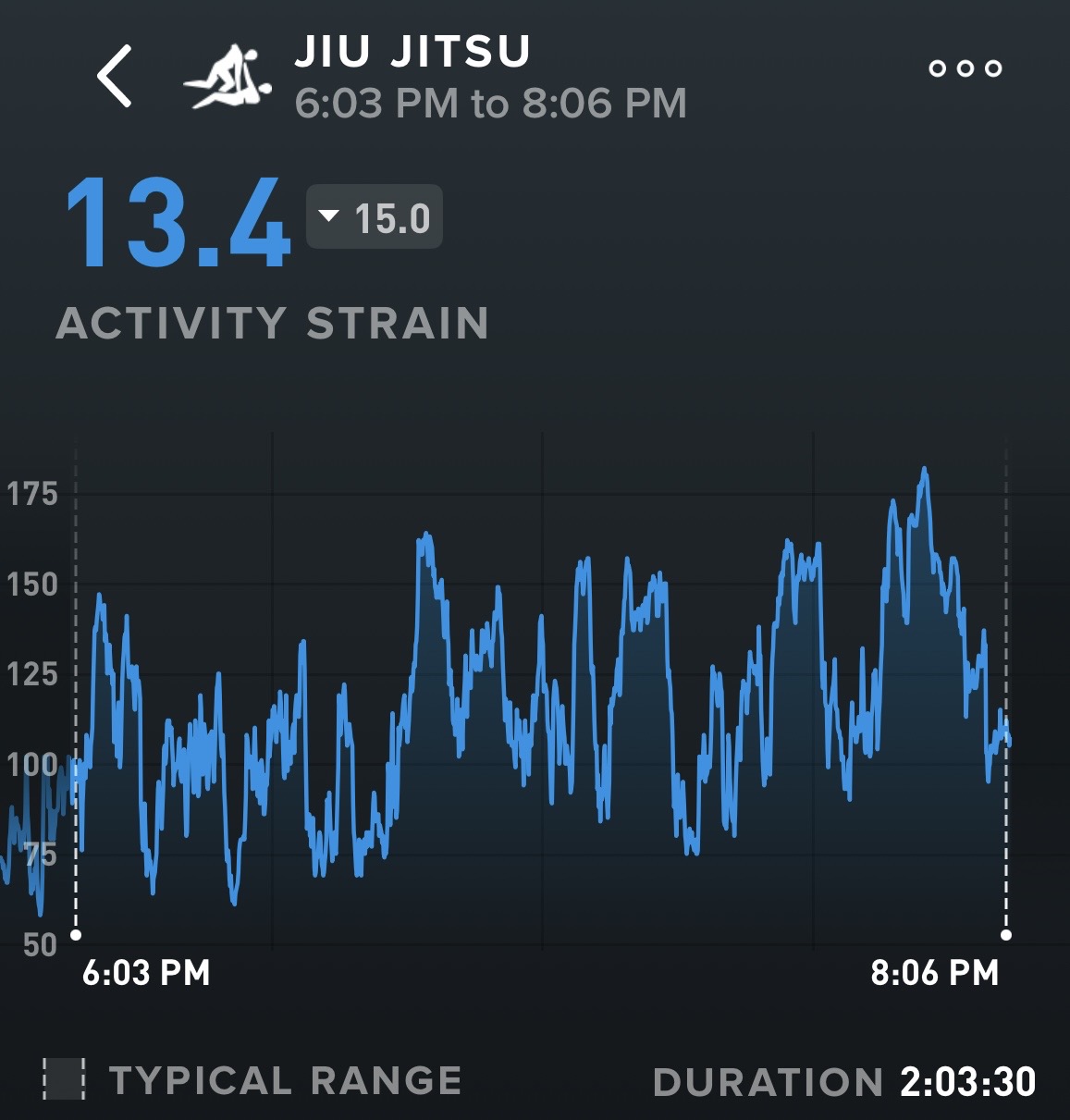
Whoop has different wearing options, including a bicep band and even clothing with built-in pockets (sports bra, compression shorts). I can actually wear it during training, and it actually captures what I'm doing. That alone made the switch worth it.
Plus, and this is key for me: no screen. No notifications. No smart features. It's just data. I check the app when I want to, not when my wrist tells me to.
What I've Learned
After going through all of this over the course of 6 years, from research-grade sports performance tech in college to consumer wearables I've tried and abandoned, here's my latest thoughts:
The "best" tracker is the one you'll actually wear. Sounds obvious, but it's true. If you can't wear it during your primary activities, or if it annoys you enough that you stop using it, it doesn't matter how good the data is.
Know what you actually care about. Do you want activity tracking? Recovery insights? Sleep data? Notifications and smart features? Different devices excel at different things, and there's no one-size-fits-all.
Your needs will change. What worked for me during my weightlifting phase didn't work once I started jiu-jitsu. That's fine. It's okay to switch devices as your life and priorities shift.
Subscription models aren't inherently bad. I resisted them for a while, but if the device actually delivers value and fits your lifestyle, the monthly cost might be worth it. For me, Whoop's subscription is worth it because I'm using it every single day in ways that matter to me.
So Which One Is Right For You? There are dozens of rings, watches, and other tech on the market... I plan to write a future blog post soon that does a deep dive into the different options on the market and key features so stay tuned 📣
The Bottom Line
I'm not here to tell you which wearable to buy. What works for me might not work for you, and that's the point! We all move differently, have different priorities, and use these things in different ways.
Right now, Whoop is working for me. Will it still be my device in two years? Maybe. Maybe not. And that's okay too. What I do know is there's so much more to learn—about recovery science, about training load, about how to actually use all this data to perform better. That's the part I'm looking forward to.
The journey is just getting started